

Shrimpin' aint EASY!
- Posted on
- By Drew Mire
- Posted in Marsh & Bayou, Shrimp Recipe
- 0
A family legacy of hard work, unforgettable stories, and the seafood that never goes out of season.
I love a good crawfish boil. I look forward to crawfish season every year, and when it arrives, so does the envie to eat them, cook with them, and work them into as many dishes as possible. But crawfish are just that: a season. And let's face it, I may be showing my age, but they are nowhere near as cheap as I remember them being in the good old days.
Shrimp, on the other hand, are steady. When the crawfish disappear, shrimp are still there year round. Their briny sweetness is cleaner to me, without that slightly muddy, metallic finish crawfish can sometimes leave behind. Don't get me wrong, I still love crawfish, but lately I have been leaning more toward shrimp.
Growing up, I always viewed shrimp as a high ticket item. Maybe it was the 1980s and 1990s steakhouses serving shrimp cocktail in those fancy martini glasses, each shrimp perfectly arranged along the rim. Or maybe it was because our childhood shrimping attempts on Lake Pontchartrain and in the Rigolets required fitting our boat with a homemade picking box that I watched my dad cuss and fight to build, cuss and fight to secure, and cuss and fight again when it did not work exactly as planned.
We hand pulled a trawl well into the darkness, then sorted through the picking box bounty while trying to avoid crab claws, catfish spines, and strange little creatures I had yet to familiarize myself with. The hope was always to catch enough decent sized shrimp for a boil or at least fill a handful of quart bags for the freezer.
Those late night adventures taught me that my dad was many things. He was a fisherman, a hunter, a handyman, a teacher, a biologist, and so much more. But he was not a shrimper. We had luck every now and then, but it was mostly dumb luck. The effort was there. The consistency was not. Catching shrimp in quantity requires more than effort. It requires technique, intuition, constant adjustment, and an understanding of wind, tide, water, and bottom. It is as much an art as the cooking that comes afterward.
Years later, I had the opportunity to watch a true artist at work: Capt. Tut Plaisance, my boys' great grandfather. He was a lifelong shrimper with no backup plan. During World War II, he served in the Navy in the Pacific Theater. He was wounded in the Aleutian Islands and earned a Purple Heart. He hand sewed duffel bags from canvas tarps to sell to naval officers and saved every penny he could. When he returned to South Louisiana, he used that money to hand build and captain his own cypress hull shrimp boat, the Rio Grande. Later came the Little Rio, a boat large enough to accommodate his most dependable free labor, his four sons.
I did not get to witness those early years, but I like to think I caught him during the perfect season of his life. He was still young enough to swing around a 35 foot skiff fitted with skimmers, but old enough to slow down and share stories that I could pass along to my boys. He spoke of catching shrimp by the barrel, 210 pounds to a barrel, in Lake Borgne. For every 20 barrels he caught, Maw Maw would sew him a new set of sheets for the boat. His face would glow like a young man in love when he talked about clean catches of monster shrimp spilling out of the trawls and onto the deck. On land, his body folded forward with age, but on the boat he moved among cables, lines, nets, and controls like a choreographed ballet. His eyes sparkled when he talked about a big catch, showed someone how to tie a trawl, build new boards, splice lines, or tie the endless knots that were second nature to him. He had found a life he loved, even if it was never the easiest path. To him, the work was not merely work. It was a blessing. There is something worth passing down in that. The right life is not always the easiest one, and sometimes the thing worth doing is the thing that takes years to learn well.
Shrimping still ain't easy, but eating shrimp certainly is. Unlike crawfish, shrimp are reasonably priced through much of the year, especially when you consider their higher meat yield. You are paying for more food and less shell. And shrimp are dangerously easy to eat. Fried or boiled, you can pop them into your mouth one after another before realizing half the platter is gone. That same one handed appeal inspired two recipes I return to often.
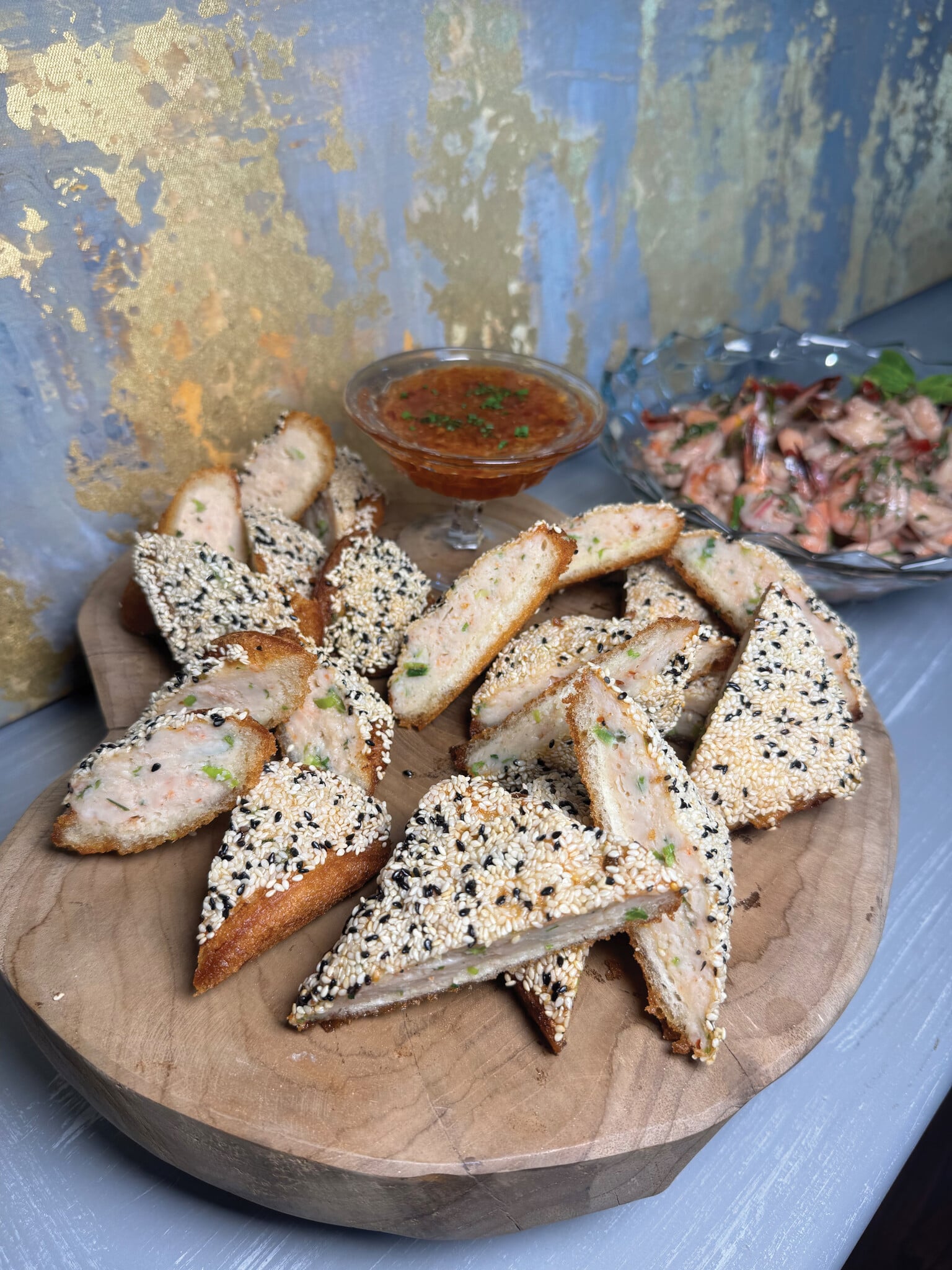
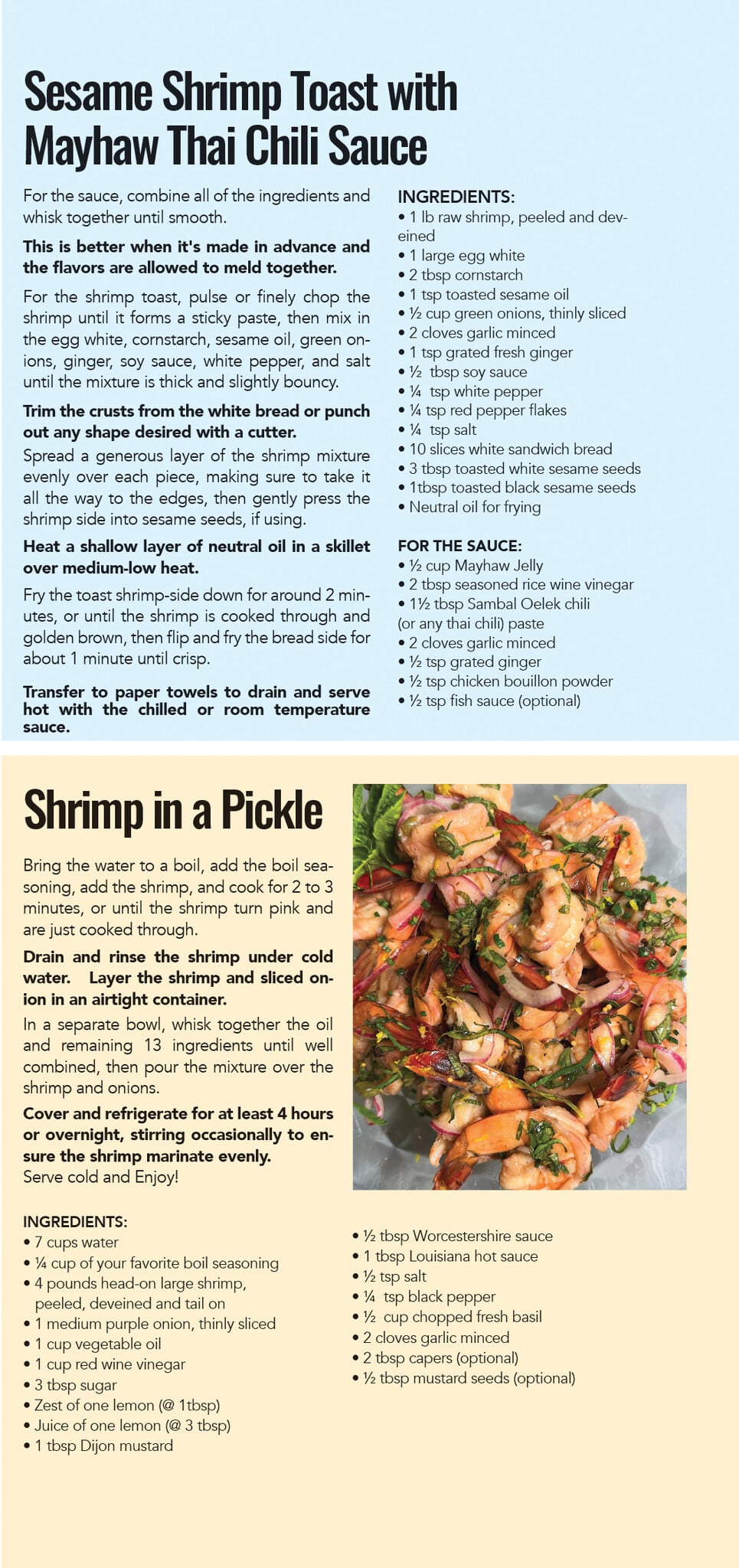
The first is Sesame Shrimp Toast with Mayhaw Thai Chili Sauce. Shrimp toast may lean Asian in technique and flavor, but the mayhaw brings it squarely back South. Mayhaws are one of those distinctly Southern late spring and early summer harvests. We almost exclusively used the small, tart red fruits to cook down into jelly. That tartness is exactly what makes mayhaw jelly work so well in this recipe. It gives the sauce sweetness and enough acidity to cut through the richness of the fried toast. The result might be Asian inspired, but with a Southern drawl.
The second recipe, Shrimp in a Pickle, lands somewhere between traditional pickled shrimp and a whole shrimp salad. It is cold, bright, acidic, and herbaceous. Best of all, the shrimp stay whole. Pick one up by the tail, eat it, and reach for another. And do not sleep on those pickled red onions.
Outside of an allergy, how could you not love shrimp? They can be humble or fancy, pulled from a trawl or perched on the rim of a martini glass. They can take sesame and ginger just as easily as boil seasoning and Louisiana hot sauce. They belong at a white tablecloth restaurant and on a newspaper covered folding table.
I love nearly every kind of seafood South Louisiana offers. But shrimp, whether fried, boiled, pickled, toasted, stewed, or peeled while standing over the kitchen sink, remain one of the hardest things for me to resist. Shrimping ain't easy. Thankfully, eating them is.
Comments
Be the first to comment...